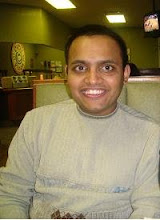
8th Feb make me realize i had lost most precious thing in World, poem devoted to my mother who has leave me alone to survive 7 years back.
Mom, you meant so much to me,
You were special,
And that's no lie
You knew how to brighten,
Even the darkest of days,
And the cloudiest of sky!
Mom,
Your smile alone,
Warmed hearts.
Your laughter,
Was like music to hear,
And completely infectious.
I would give absolutely anything,
To have you well,
And standing near.
Not a second passes,
When you are not on my mind.
Your never ending love,
I will never forget.
The hurt will ease in time.
Many tears I have seen,
Many tears I have cried.
They have all poured out like rain.
I know that you are in a place,
Where there is no pain.
But I sure do miss you,
For you were my friend,
My Sister,
And most of all my Mother.
Your passing came far too soon,
No warning,
No sound.
If only,
I could have you here,
For just one more day!
Friday, February 8, 2008

Wednesday, November 21, 2007
Rituals
Just ponder over, God who feeds the whole universe, can we feed Him? It is not correct. He who is the source of light for the whole world, is it correct to light a lamp or a candle for Him or in front of His idol? No! It only shows our ignorance (foolishness). Is it possible for us to make Him happy by offerings of the fragrance of few flowers or a few coins or even few currency notes? Actually, man is very selfish by nature. He feels by doing so (offering a few things), he can buy (acquire) His kindness and will be free to act in any fashion. This is like living in a fool’s paradise.
Real devout is one who obeys the commandments of God – the words of God – the Vedas. He has to be inquisitive and get the answers for his/her queries from Vedic scholars only. He/she has to improve his/her conduct & character. He/she has to behave with all the creatures of this universe with love, respect & affection according to the principles of ‘Dharma’ (humanity) and in a suitable manner. He/she should acquire true knowledge and spread the same freely without any favour. Study of the Vedas and Vedic scriptures is the only way to obtain the true knowledge about materialistic & Spiritual world.
Personally i feel we should visit temples without hesitation to appreciate the art & culture hidden there. These places can also be visited, if they are the seats of ‘Brahmins’ (by virtues, actions & temperament and not only by birth) who conduct and perform the Yajna Karmas – the fire rituals, act as Gurus, adore the formless God and act as human guides & mentors for the public and persons visiting these places. They can also serve these places like ancient ‘Ashrams’ - Places of learning and mental peace.
Real devout is one who obeys the commandments of God – the words of God – the Vedas. He has to be inquisitive and get the answers for his/her queries from Vedic scholars only. He/she has to improve his/her conduct & character. He/she has to behave with all the creatures of this universe with love, respect & affection according to the principles of ‘Dharma’ (humanity) and in a suitable manner. He/she should acquire true knowledge and spread the same freely without any favour. Study of the Vedas and Vedic scriptures is the only way to obtain the true knowledge about materialistic & Spiritual world.
Personally i feel we should visit temples without hesitation to appreciate the art & culture hidden there. These places can also be visited, if they are the seats of ‘Brahmins’ (by virtues, actions & temperament and not only by birth) who conduct and perform the Yajna Karmas – the fire rituals, act as Gurus, adore the formless God and act as human guides & mentors for the public and persons visiting these places. They can also serve these places like ancient ‘Ashrams’ - Places of learning and mental peace.
Tuesday, September 4, 2007
Woh Subaha Kabhi to Ayegi
Nehru's `tryst with destiny' suggested that India would wake up to a new day. The country has made substantial material progress since that fateful and historic day 60 years back. But the freedom struggle had other goals as well. Countless people `sacrificed their today for a better tomorrow for us'. Have we achieved that better today? Was there not a different vision than the one that we have worked for? Doubts arise not only because mass poverty persists, illiteracy is rampant and insanitary conditions and ill health continue to take a heavy toll but because we hardly have a vision left except to follow the West and in the process we have perhaps got the worst of both the worlds.
In material terms, a few, numbering less than 3% of the population, have done well while the rest are trapped in a low level equilibrium. We boast of more billionaires than Japan while in terms of per capita income we are in the bottom twenty out of 177 nations. The former then is a reflection of terrible inequity and nothing to gloat about. Largest number of people below the poverty line, farmers suicides, huge urban slums, fields in and around cities functioning as vast toilets, the inability of the so called literates to understand modern technology, etc., suggest that the nation as a whole has yet to awake to a new morning.
In the 1958 movie, `Phir Subaha Hogi', Mukesh singing with pathos, "Woh Subaha Kabhi to Ayegi" (That morning will come some time), epitomized the dream of the common Indian of the Fifties and the Sixties. Many of us as children internalized the idea that we will build a better future for all our countrymen and perhaps we would build a new civilization that would surpass the West. Sixty years after independence perhaps the shreds of this dream are not even left in the dustbins of those in power and supposedly guiding the destiny of this nation. That dream has been blown away in the hurricane of achieving 9% growth.
The song is not just about eliminating poverty, hunger, ill health and illiteracy but about a dream of building a different society – a peaceful one where everyone (specially the marginalized) would live with dignity. Gandhi's "last Person First". The song defines that happy morning as "Jab ambar jhum ke nachega, Jab dharti nagme gayegi". When the sky would dance with joy and the Earth would sing songs. Today, at our low per capita consumption, the air, water and land are terribly polluted and weeping rather than singing and dancing. The most revered Ganga or Godavari are heavily polluted, their beds contaminated with huge amounts of toxic material that would affect the future generations. Even the sacred is no more sacred, so what is sacrosanct?
The song goes "Jab dukh ke badal pighlenge" (when the clouds of sorrow will melt). "Insano ki izzat jab jhute sikkon me na toli jayegi" (when people's dignity would not be measured by false money). "Mana ki abhi tere mere armano ki kimat kuch bhi nahin", (Agreed that today our dreams have no value). But their was belief, one day this would change. For the vast numbers of the marginalized sections, sorrow is a daily and endless fare that is not melting away. Dozens of their children can disappear in Nithari and little is done. The only escape is what Bollywood dishes out - sex and violence. The government provides little relief since it fails to deliver. Faith in politicians is a casualty. The dignity of the poor is even more firmly mortgaged to money when unemployment is so high and the youth has to take to crime to fulfill its expectations. The dreams of the deprived have no value to the rulers who in their self centerdness can only see in them the means to fulfill their own narrow dreams of great riches, like, in the misallocation of land meant for the poor displaced slum dwellers.
Today labour is devalued while speculation and greed have been raised to a new high pedestal. A mere 1% of the population linked to the corporate sector earns more than what 60%, dependent on agriculture, do. Disparities have risen more sharply in the last 6 years than in the earlier 54 years. The young are encouraged to sell soap but not to contribute to nation building through teaching and research. Sacrifice appears to be stupidity, undermining the entire effort of the freedom fighters. Those of them who still survive ruefully ask, is this what they fought for?
The 3%, the ruling elite of the nation aspire to join the international elite, sending its children to study college abroad, going there for vacations or to hospitals for health problems. It is voting with its feet. A school in Chappra or a dispensary in Ghungrawali has little value to it but Delhi must have 24 hours water and electricity. That is progress. The emotional attachment with the nation is gone.Corruption is rampant both in the public and the private sectors. Institutions, like the legislatures, judiciary and the bureaucracy, are breaking down. The elite is lawless breaking every single law – from traffic laws to building bye-laws to industrial and environmental laws. Many of the rich have earned more through illegal means than legal ones. The political leaders hardly represent the people - leading a life of luxury. Democracy is a great institution but in India it has been turned into a fine art for self aggrandizement. The bankruptcy of our leadership led to our jettisoning of the ideas of independent development in the Eighties and of the `last person first' in the Nineties.
From tall leaders like Gandhi who could give up everything to the present day leadership that cannot give up anything. From the idea of voluntary poverty to the notion of greed as the driving force of our society. From society and nation to the self. The transition has been made from a national vision for all to a vision for a few. We are going in the direction opposite to the line in Mukesh's song, "Miti ka bhi kuch mol magar insano ki kimat kuch bhi nahin" (Even earth has some value but human beings have none). Farmers commit suicide in increasing numbers and packages are announced with little effect.
The land of Gandhi has turned into the land of the bania (not that he was not a bania). The credit for this goes to the very party which Gandhi built. Clever ones would shamelessly argue, even Gandhi would have done the same in the present context. Would they consider that a man given to simplicity, sacrifice and truth and not show, half truths and consumerism would have blanched at this suggestion?
From the notion that the ills of our society have a social cause to the idea that the individual is to blame for her predicament, it is a long journey. Everyone has now to go to the market to get what they need, government is no more responsible for elimination of poverty, etc.. The devil may take the hindmost.
Nations are built on dreams but we have narrowed it to money making. So how do we build a great nation as `Nehru's tryst' suggested or to which Mukesh referred to in the song, Jis subaha ki khatir yug yug se ham sab mar mar ke jite aiyen hain. (That morning for whose sake from eons we all have been living by dying a thousand deaths). Gandhi had a dream for the nation that the party he helped build has shattered. He perhaps saw what was coming so he wanted the party to dissolve itself so that this farce would not have occurred. He wanted the Rashtrapati Bhavan to be converted into a hospital not because that would have been functional but because that would have given birth to many more dreams rather than converting the freedom fighters into rulers in the imperial mould. So Sixty years down the road we are still waiting for that new dawn in the midst of 9% growth. Mukesh would have to sing, `Who Subaha Abhi to Nahin Ayegi'.
In material terms, a few, numbering less than 3% of the population, have done well while the rest are trapped in a low level equilibrium. We boast of more billionaires than Japan while in terms of per capita income we are in the bottom twenty out of 177 nations. The former then is a reflection of terrible inequity and nothing to gloat about. Largest number of people below the poverty line, farmers suicides, huge urban slums, fields in and around cities functioning as vast toilets, the inability of the so called literates to understand modern technology, etc., suggest that the nation as a whole has yet to awake to a new morning.
In the 1958 movie, `Phir Subaha Hogi', Mukesh singing with pathos, "Woh Subaha Kabhi to Ayegi" (That morning will come some time), epitomized the dream of the common Indian of the Fifties and the Sixties. Many of us as children internalized the idea that we will build a better future for all our countrymen and perhaps we would build a new civilization that would surpass the West. Sixty years after independence perhaps the shreds of this dream are not even left in the dustbins of those in power and supposedly guiding the destiny of this nation. That dream has been blown away in the hurricane of achieving 9% growth.
The song is not just about eliminating poverty, hunger, ill health and illiteracy but about a dream of building a different society – a peaceful one where everyone (specially the marginalized) would live with dignity. Gandhi's "last Person First". The song defines that happy morning as "Jab ambar jhum ke nachega, Jab dharti nagme gayegi". When the sky would dance with joy and the Earth would sing songs. Today, at our low per capita consumption, the air, water and land are terribly polluted and weeping rather than singing and dancing. The most revered Ganga or Godavari are heavily polluted, their beds contaminated with huge amounts of toxic material that would affect the future generations. Even the sacred is no more sacred, so what is sacrosanct?
The song goes "Jab dukh ke badal pighlenge" (when the clouds of sorrow will melt). "Insano ki izzat jab jhute sikkon me na toli jayegi" (when people's dignity would not be measured by false money). "Mana ki abhi tere mere armano ki kimat kuch bhi nahin", (Agreed that today our dreams have no value). But their was belief, one day this would change. For the vast numbers of the marginalized sections, sorrow is a daily and endless fare that is not melting away. Dozens of their children can disappear in Nithari and little is done. The only escape is what Bollywood dishes out - sex and violence. The government provides little relief since it fails to deliver. Faith in politicians is a casualty. The dignity of the poor is even more firmly mortgaged to money when unemployment is so high and the youth has to take to crime to fulfill its expectations. The dreams of the deprived have no value to the rulers who in their self centerdness can only see in them the means to fulfill their own narrow dreams of great riches, like, in the misallocation of land meant for the poor displaced slum dwellers.
Today labour is devalued while speculation and greed have been raised to a new high pedestal. A mere 1% of the population linked to the corporate sector earns more than what 60%, dependent on agriculture, do. Disparities have risen more sharply in the last 6 years than in the earlier 54 years. The young are encouraged to sell soap but not to contribute to nation building through teaching and research. Sacrifice appears to be stupidity, undermining the entire effort of the freedom fighters. Those of them who still survive ruefully ask, is this what they fought for?
The 3%, the ruling elite of the nation aspire to join the international elite, sending its children to study college abroad, going there for vacations or to hospitals for health problems. It is voting with its feet. A school in Chappra or a dispensary in Ghungrawali has little value to it but Delhi must have 24 hours water and electricity. That is progress. The emotional attachment with the nation is gone.Corruption is rampant both in the public and the private sectors. Institutions, like the legislatures, judiciary and the bureaucracy, are breaking down. The elite is lawless breaking every single law – from traffic laws to building bye-laws to industrial and environmental laws. Many of the rich have earned more through illegal means than legal ones. The political leaders hardly represent the people - leading a life of luxury. Democracy is a great institution but in India it has been turned into a fine art for self aggrandizement. The bankruptcy of our leadership led to our jettisoning of the ideas of independent development in the Eighties and of the `last person first' in the Nineties.
From tall leaders like Gandhi who could give up everything to the present day leadership that cannot give up anything. From the idea of voluntary poverty to the notion of greed as the driving force of our society. From society and nation to the self. The transition has been made from a national vision for all to a vision for a few. We are going in the direction opposite to the line in Mukesh's song, "Miti ka bhi kuch mol magar insano ki kimat kuch bhi nahin" (Even earth has some value but human beings have none). Farmers commit suicide in increasing numbers and packages are announced with little effect.
The land of Gandhi has turned into the land of the bania (not that he was not a bania). The credit for this goes to the very party which Gandhi built. Clever ones would shamelessly argue, even Gandhi would have done the same in the present context. Would they consider that a man given to simplicity, sacrifice and truth and not show, half truths and consumerism would have blanched at this suggestion?
From the notion that the ills of our society have a social cause to the idea that the individual is to blame for her predicament, it is a long journey. Everyone has now to go to the market to get what they need, government is no more responsible for elimination of poverty, etc.. The devil may take the hindmost.
Nations are built on dreams but we have narrowed it to money making. So how do we build a great nation as `Nehru's tryst' suggested or to which Mukesh referred to in the song, Jis subaha ki khatir yug yug se ham sab mar mar ke jite aiyen hain. (That morning for whose sake from eons we all have been living by dying a thousand deaths). Gandhi had a dream for the nation that the party he helped build has shattered. He perhaps saw what was coming so he wanted the party to dissolve itself so that this farce would not have occurred. He wanted the Rashtrapati Bhavan to be converted into a hospital not because that would have been functional but because that would have given birth to many more dreams rather than converting the freedom fighters into rulers in the imperial mould. So Sixty years down the road we are still waiting for that new dawn in the midst of 9% growth. Mukesh would have to sing, `Who Subaha Abhi to Nahin Ayegi'.
Saturday, August 11, 2007
Inequality
What can be said about inequality, is it inevitable or created by human like us, this is one of the word that make my mind to think become atheist, why this word exist in this world every religion gives answer in its own way but i have not find a suitable answer, if we talk about reincarcaration what is starting point of inequality, what is reason for birth of first handicapped person, Most of us think that we are successful because of our hard work or blah blah but do we being the same human being if our initial conditions are not the same, in mathematical term solution of diffrential equation solution depends strongly on initial boundary condition, who decide initial boundary condition and why not all of us get the same.
When we are living in free society we have every right to do what we want to do, but i feel it very depressing when i am in condition to live a luxurious life while millions human being like me are starving of hunger, i never think twice to spend 1000-2000 in a day while the same amount can stop farmer from doing suicide, or my one day pleasure is equal to one human being life, is it not frustrating Why such a difference in world and what can we do for that? This is a question that is disturbing me from last 2-3 nights, more i think about this more i become disturbed.
I don't find a solution,but this thinking make me more humble and sensitive, if things are random is it not my luck that i got a good boundary condition and able to write a blog while many others who assigned life at same time as mine hardly know how to read and write.
Do i have to leave everything and go to leave in village if a talk about these high philosphy or can i make a difference by changing my life style from here also, should i work hard to become a millioner or work to make 100-1000 people like me who can live a comfortable life, for example instead of buying a costly car i can buy a decent second hand car and use rest of money to do something that can reduce this inequality by a small fraction.
When we are living in free society we have every right to do what we want to do, but i feel it very depressing when i am in condition to live a luxurious life while millions human being like me are starving of hunger, i never think twice to spend 1000-2000 in a day while the same amount can stop farmer from doing suicide, or my one day pleasure is equal to one human being life, is it not frustrating Why such a difference in world and what can we do for that? This is a question that is disturbing me from last 2-3 nights, more i think about this more i become disturbed.
I don't find a solution,but this thinking make me more humble and sensitive, if things are random is it not my luck that i got a good boundary condition and able to write a blog while many others who assigned life at same time as mine hardly know how to read and write.
Do i have to leave everything and go to leave in village if a talk about these high philosphy or can i make a difference by changing my life style from here also, should i work hard to become a millioner or work to make 100-1000 people like me who can live a comfortable life, for example instead of buying a costly car i can buy a decent second hand car and use rest of money to do something that can reduce this inequality by a small fraction.
Saturday, March 3, 2007
Poverty free civilization
We get what we want, or what we don't refuse. We accept the fact that we will always have poor people around us, and that poverty is part of human destiny. This is precisely why we continue to have poor people around us. If we firmly believe that poverty is unacceptable to us, and that it should not belong to a civilized society, we would have built appropriate institutions and policies to create a poverty-free world.
We wanted to go to the moon, so we went there. We achieve what we want to achieve. If we are not achieving something, it is because we have not put our minds to it. We create what we want.
What we want and how we get to it depends on our mindsets. It is extremely difficult to change mindsets once they are formed. We create the world in accordance with our mindset. We need to invent ways to change our perspective continually and reconfigure our mindset quickly as new knowledge emerges. We can reconfigure our world if we can reconfigure our mindset.
I believe that we can create a poverty-free world because poverty is not created by poor people. It has been created and sustained by the economic and social system that we have designed for ourselves; the institutions and concepts that make up that system; the policies that we pursue.
Poverty is created because we built our theoretical framework on assumptions which under-estimates human capacity, by designing concepts, which are too narrow (such as concept of business, credit- worthiness, entrepreneurship, employment) or developing institutions, which remain half-done (such as financial institutions, where poor are left out). Poverty is caused by the failure at the conceptual level, rather than any lack of capability on the part of people.
I firmly believe that we can create a poverty-free world if we collectively believe in it. In a poverty-free world, the only place you would be able to see poverty is in the poverty museums. When school children take a tour of the poverty museums, they would be horrified to see the misery and indignity that some human beings had to go through. They would blame their forefathers for tolerating this inhuman condition, which existed for so long, for so many people.
A human being is born into this world fully equipped not only to take care of him or herself, but also to contribute to enlarging the well being of the world as a whole. Some get the chance to explore their potential to some degree, but many others never get any opportunity, during their lifetime, to unwrap the wonderful gift they were born with. They die unexplored and the world remains deprived of their creativity, and their contribution.
To me poor people are like bonsai trees. When you plant the best seed of the tallest tree in a flower-pot, you get a replica of the tallest tree, only inches tall. There is nothing wrong with the seed you planted, only the soil-base that is too inadequate. Poor people are bonsai people. There is nothing wrong in their seeds. Simply, society never gave them the base to grow on. All it needs to get the poor people out of poverty for us to create an enabling environment for them. Once the poor can unleash their energy and creativity, poverty will disappear very quickly.
Let us join hands to give every human being a fair chance to unleash their energy and creativity.
We wanted to go to the moon, so we went there. We achieve what we want to achieve. If we are not achieving something, it is because we have not put our minds to it. We create what we want.
What we want and how we get to it depends on our mindsets. It is extremely difficult to change mindsets once they are formed. We create the world in accordance with our mindset. We need to invent ways to change our perspective continually and reconfigure our mindset quickly as new knowledge emerges. We can reconfigure our world if we can reconfigure our mindset.
I believe that we can create a poverty-free world because poverty is not created by poor people. It has been created and sustained by the economic and social system that we have designed for ourselves; the institutions and concepts that make up that system; the policies that we pursue.
Poverty is created because we built our theoretical framework on assumptions which under-estimates human capacity, by designing concepts, which are too narrow (such as concept of business, credit- worthiness, entrepreneurship, employment) or developing institutions, which remain half-done (such as financial institutions, where poor are left out). Poverty is caused by the failure at the conceptual level, rather than any lack of capability on the part of people.
I firmly believe that we can create a poverty-free world if we collectively believe in it. In a poverty-free world, the only place you would be able to see poverty is in the poverty museums. When school children take a tour of the poverty museums, they would be horrified to see the misery and indignity that some human beings had to go through. They would blame their forefathers for tolerating this inhuman condition, which existed for so long, for so many people.
A human being is born into this world fully equipped not only to take care of him or herself, but also to contribute to enlarging the well being of the world as a whole. Some get the chance to explore their potential to some degree, but many others never get any opportunity, during their lifetime, to unwrap the wonderful gift they were born with. They die unexplored and the world remains deprived of their creativity, and their contribution.
To me poor people are like bonsai trees. When you plant the best seed of the tallest tree in a flower-pot, you get a replica of the tallest tree, only inches tall. There is nothing wrong with the seed you planted, only the soil-base that is too inadequate. Poor people are bonsai people. There is nothing wrong in their seeds. Simply, society never gave them the base to grow on. All it needs to get the poor people out of poverty for us to create an enabling environment for them. Once the poor can unleash their energy and creativity, poverty will disappear very quickly.
Let us join hands to give every human being a fair chance to unleash their energy and creativity.
Subscribe to:
Comments (Atom)